Business Rule Driven Design

An architectural pattern focused on making business rules the absolute protagonists of software development.
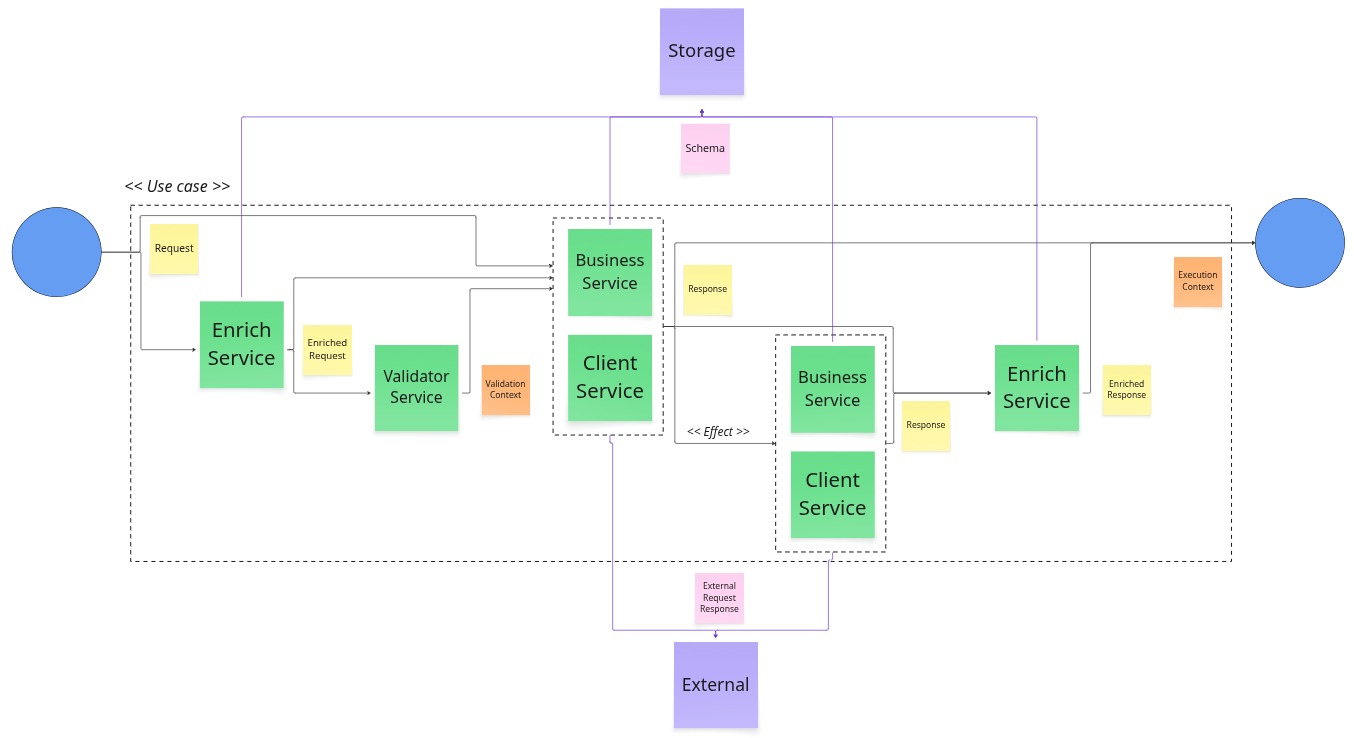
BRDD Architecture

The BRDD Manifesto

πŸ€– AI-First Architectural Design

How to Apply BRDD

1. Semantic Libraries

Import our native libraries to enforce the pattern structurally via code.

2. AI Prompting (AGENTS.md)

Instruct your IDE (Cursor, Copilot) to follow the pattern without any dependencies.

Example AGENTS.md Snippet
# Architectural Rules
This project strictly follows the Business Rule Driven Design (BRDD) pattern.
When creating, refactoring, or modifying business logic, you MUST adhere to these rules:
1. Orchestration: Use Cases MUST return a standardized ExecutionContext (containing data, setters, effects, and errors), never raw data.
2. Validation: Isolate all validation logic into a dedicated ValidateService. Use Cases must not contain validation IFs.
3. Traceability: Map all rules, validations, setters, and side effects with unique business codes (e.g., RULE_001, EFF_001).
4. Isolation: Never mix external I/O (DB calls, APIs) directly into the business logic. Use specialized Clients or Listeners.

For the full specification and structural blueprint, refer to the official documentation:
https://github.com/brdd-design/brdd/blob/main/BRDD.md

Ecosystem Modules

The BRDD project is modular, allowing you to adopt only the parts that fit your architecture.

Stable
πŸ’Ž

BRDD Core

The foundation. Unified response, execution context, and service specialization.

Stable
⚑

BRDD Async

Asynchronous flows, messaging, and event-driven patterns.

In Validation
βš™οΈ

Async BPMN

Visual orchestration using BPMN standard and BBJN notation.

In Validation
πŸ”—

Async Chain

Decentralized execution on Blockchain for high-trust processes.

In Validation
☁️

BRDD Cloud

Resource traceability and neutral cloud naming conventions.

Modules in Validation Phase are being tested in production scenarios to ensure stability before official release.

BRDD Flow Architecture

A visual representation of the core Business Rule Driven Design data flow.

BRDD Core Flow Visual Diagram
View Detailed UML Diagrams

Knowledge Hub: Articles & Guides

Deep dive into BRDD concepts, origin stories, and practical implementations.

β†’ β†’ β†’

Repository Hub (Native Libraries)

The BRDD core ported to the 6 most used languages in the market. Ready for enterprise adoption.

Python

Python

View Repository
TypeScript

TypeScript

View Repository
Go

Go

View Repository
Rust

Rust

View Repository
.NET

.NET

View Repository
Java

Java

View Repository
PHP

PHP

View Repository

Quick Reference Hub

All official links, installation commands, and documentation in one place.

Resource Type Install / Access
🐍 BRDD Python Library pip install brdd-python
πŸ“œ BRDD TypeScript Library npm install @brdd-design/core
πŸ”· BRDD .NET Library dotnet add package Brdd.Design.Core
πŸ¦€ BRDD Rust Library cargo add brdd-rust
🐹 BRDD Go Library go get github.com/brdd-design/brdd-go
β˜• BRDD Java Library io.github.brdd-design:brdd-java
🐘 BRDD PHP Library composer require brdd/brdd-php
πŸ“– The Manifesto Core Doc GitHub / Markdown
πŸ“š Knowledge Hub Articles Guides & Stories
⚑ Async Specification Extension GitHub / Markdown
πŸ§ͺ Async Examples Examples Python / TS / .NET
πŸ”΅ BRDD Hub Repository Main Organization Hub